Segmented Turning
May 6, 2026
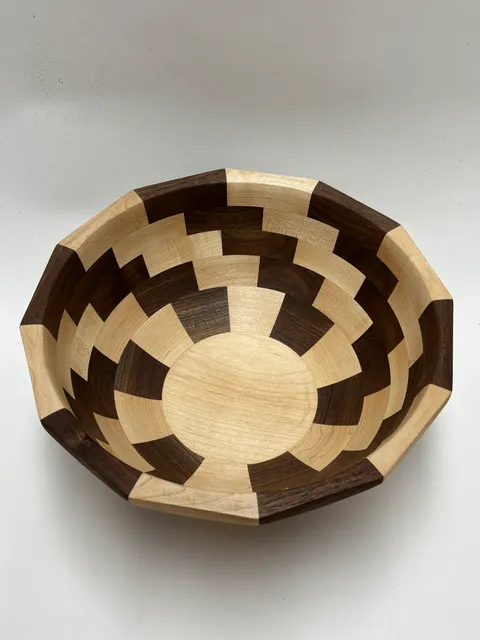
Segmented turning transforms hundreds of individual pieces into flowing vessels, sculptural forms, and intricate patterns that seem almost impossible once they begin spinning on the lathe. It’s where woodworking meets geometry, patience, and art.
The Art of Segmented Turning
When Woodworking Becomes Geometry, Patience, and Sculpture
There’s something almost hypnotic about segmented turning.
At first glance, many people assume a segmented piece is carved from a single block of wood. But when you look closer, you begin to see the rhythm hidden inside it — hundreds of precisely cut pieces arranged into patterns, rings, and flowing forms that only fully reveal themselves once the piece begins spinning on the lathe.
Segmented turning is one of the most intricate forms of woodturning, blending woodworking, mathematics, design, and sculpture into a single process. Every line, every angle, and every joint matters. A tiny error multiplied across an entire ring can throw everything off. But when everything comes together correctly, the result feels almost impossible — seamless geometry flowing like natural grain.
Building a Form One Piece at a Time
Unlike traditional turning, where a vessel is shaped from a single piece of wood, segmented turning begins with many individual pieces cut at exact angles. These segments are assembled into rings, stacked together, and then shaped on the lathe into the final form.
What makes segmented work so fascinating is the ability to create patterns that simply cannot exist naturally in wood. Contrasting species, flowing spirals, floating feature rings, geometric illusions, and intricate inlays become possible because the maker controls every individual component before the turning even begins.
In many ways, segmented turning feels closer to architecture than standard woodworking.
Every ring is a structure.
Every joint is part of the engineering.
Every species of wood becomes part of a larger composition.
The Beauty Hidden in Precision
One of the things I love most about segmented work is the quiet precision behind it.
Before a single cut is made on the lathe, there are hours spent designing proportions, calculating angles, selecting grain orientation, and deciding how different woods will interact with each other once finished. Some pieces may contain dozens of rings and hundreds of individual segments.
And yet, the goal is often to make all of that complexity disappear.
The best segmented pieces don’t scream for attention because of the math behind them. They feel effortless. Balanced. Organic. The geometry fades away and what remains is flow, movement, and form.
That’s where segmented turning becomes art.
Figured Wood Changes Everything
Highly figured woods bring an entirely different level of life into segmented work.
Curly maple can shimmer as the light moves across it. Walnut adds depth and warmth. Exotic species introduce contrast, color, and texture. Even subtle changes in grain direction can create movement once the piece is spinning.
No two boards are alike, which means no two segmented turnings are ever truly repeatable.
That uniqueness is part of what keeps me coming back to the process.
Every piece becomes a collaboration between design and the natural character of the wood itself.
Why Segmented Turning Captivates Me
For me, segmented turning sits at the intersection of everything I love about making.
It combines precision with creativity.
Structure with fluidity.
Planning with discovery.
Some days the process feels mathematical. Other days it feels almost meditative. There’s a certain moment — usually when the rough geometric stack first begins transforming into a flowing form on the lathe — where the piece suddenly comes alive.
That moment never gets old.
Whether it’s a vessel, bowl, hollow form, lamp base, or sculptural piece, segmented turning allows me to create forms that feel intentional, balanced, and completely one-of-a-kind.
And that’s ultimately what I chase in my work:
Not just making objects…
…but creating pieces that carry movement, light, texture, and presence long after the tools are turned off.
Now Showing — Boothbay Harbor Artisans
May 8, 2026
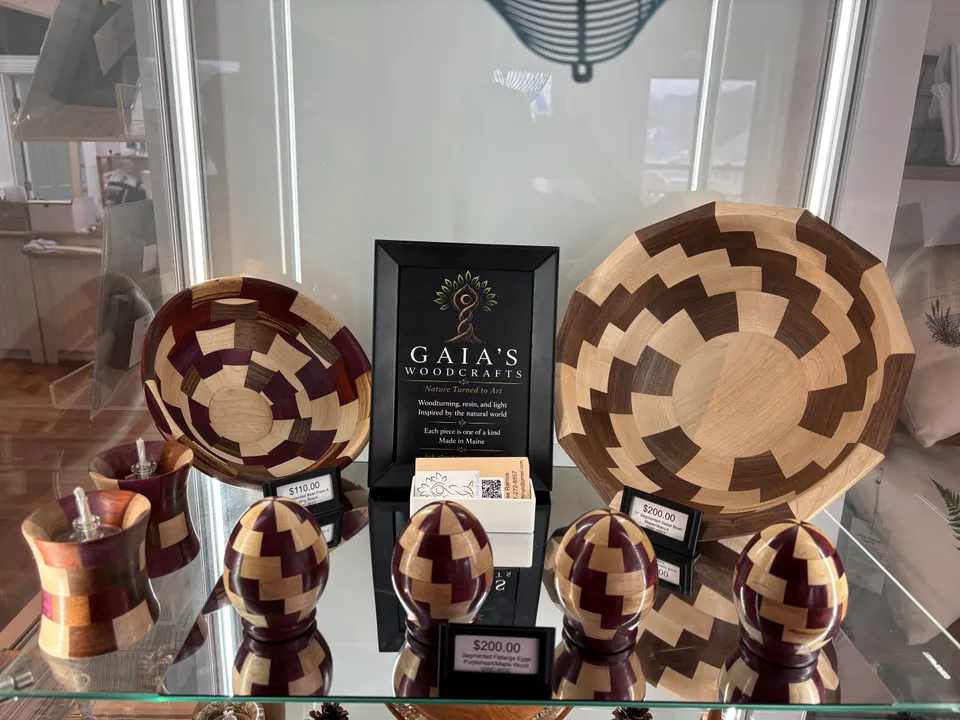
Starting this weekend, my work is on display at Boothbay Harbor Artisans at 10 Oak Street Boothbay/ ME. If you are already planning a trip to the Botanical Gardens, it is the perfect side trip.
Big news — starting this Saturday, May 8th, my woodturning and resin art will be on display at Boothbay Harbor Artisans, located at 10 Oak Street in Boothbay Harbor, Maine.
If you have been thinking about a day trip down the coast, here is a reason to make it happen. The gallery is just a short drive from the Coastal Maine Botanical Gardens — one of the most beautiful spots in New England. Make a full day of it: walk the gardens, then stop in and see the pieces in person on your way through town.
There is something about holding a finished bowl that photos just cannot capture — the weight of it, the warmth of the wood, the way the resin catches the light at different angles. The display case is full right now: segmented bowls, spalted maple, seashell-rimmed pieces, pinecone eggs, goblets, and more. Prices range from $60 up to $225.
Through Memorial Day weekend the gallery is open on weekends. After Memorial Day we go seven days a week, so whether you are a local or spending the summer up the coast, there will be plenty of opportunity to stop in.
Boothbay Harbor Artisans · 10 Oak Street · Boothbay Harbor, Maine
Follow along on Instagram for updates, or reach out through the Contact page. Hope to see you there.
Combining Resin and Wood: What I've Learned
April 10, 2026
Resin opens up a world of possibilities — capturing light, color, and even objects inside a piece. But it also introduces a whole new set of challenges that took me time to understand.
Resin opens up a world of possibilities — capturing light, color, and even objects inside a piece. But it also introduces a whole new set of challenges that took me time to understand. The first time I poured resin into a live-edge void, I thought it would be simple. It wasn't.
The biggest lesson: resin and wood move differently. Wood breathes with humidity and temperature. Resin doesn't. If the bond between them isn't strong — if the wood wasn't properly sealed or the resin wasn't fully cured — you'll see cracking or delamination weeks later. Preparation matters more than the pour itself.
I now seal every wood surface that will contact resin with a thin coat first, letting it penetrate the grain before the main pour. This locks out moisture and creates a mechanical bond that holds. I also work in a temperature-controlled space because resin is sensitive — too cold and it cures cloudy, too warm and it can yellow or bubble.
The creative side is endlessly fun. I've embedded pinecones, shells, mica pigments, and even dried moss. The key is making sure anything organic is completely dry before it goes in — moisture will ruin the cure every time. Once you solve the technical side, resin becomes another brushstroke in the palette.
Lidded Boxes: Small Forms, Big Decisions
March 22, 2026
There's something about a lidded box that demands precision in a way a bowl doesn't. The fit of the lid is the first thing people reach for, and it tells them everything about the maker.
There's something about a lidded box that demands precision in a way a bowl doesn't. The fit of the lid is the first thing people reach for, and it tells them everything about the maker. Too tight and it's frustrating. Too loose and it feels cheap. The sweet spot — a gentle resistance that releases with a soft pop — takes practice to find consistently.
I turn boxes from a single blank whenever possible. Cutting the lid from the same piece means the grain flows continuously from body to lid, which is visually satisfying and also practical: the wood has already moved together as a unit.
Wall thickness is the other variable I obsess over. Too thick and the piece feels heavy and ungraceful. Too thin and you risk blowout while hollowing, and the finished piece feels fragile. For most of my cherry and apple boxes, I aim for walls around 3–4mm — thin enough to feel refined, thick enough to hold.
The interior finish matters as much as the outside. I sand the inside to the same grit as the exterior and apply the same finish. When someone opens the box and sees a smooth, thoughtfully finished interior, they understand it was made with care — not just shaped on the outside and forgotten within.
The Magic of Spalted Wood
April 28, 2026
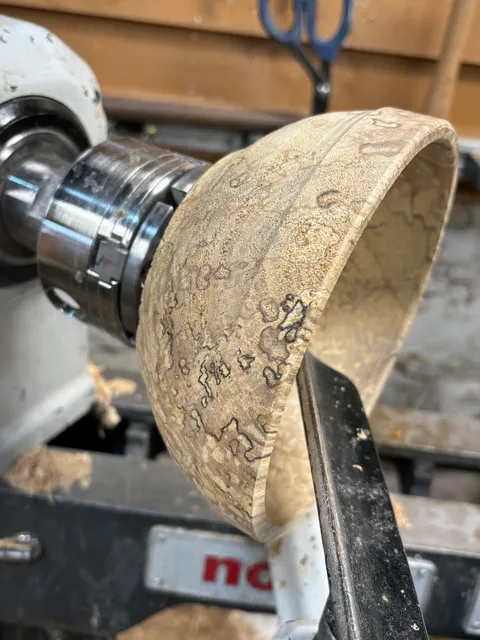
Spalting is nature's own artwork — a process where fungi move through fallen timber and leave behind bold ink-like lines and ghost zones that no human hand could design.
Spalting is nature's own artwork — a process where fungi move through fallen timber and leave behind bold ink-like lines and ghost zones that no human hand could design. When I find a piece of spalted maple or apple wood, I'm not just looking at raw material. I'm looking at a record of time.
The challenge with spalted wood is timing. Too early, and the figuring hasn't developed. Too late, and the wood becomes punky — soft, unstable, impossible to turn cleanly. There's a narrow window where the fungi have done their best work and the wood is still sound enough to take to the lathe.
Once you're there, the turning itself is meditative. The lines reveal themselves as the shape takes form, shifting and moving depending on the angle of cut. No two pieces from the same blank will ever look the same. That's what keeps me coming back to it.
A few tips if you're working with spalted material: seal the end grain as soon as you cut it to slow moisture loss, keep your tools sharp (punky areas tear rather than cut cleanly), and be patient with the finish. Spalted wood is thirsty and will absorb more than you expect on the first coat.